Showing posts with label Politics in Colombia. Show all posts

Wednesday, March 25, 2015

With the Article 22 of the National Plan of Development,
the Drummond wins and the state loses.


Image result for drummond mining pics

The National Development Plan in Colombia which is pending in Congress, includes an article that seeks to automatically extend the contracts of mining contribution not agreed to have extensions.
This was denounced by House Representative for the Party of the U of the Department of Cesar, Christian José Moreno Villamizar, who said that the adoption of Article 22 of the Law Project on the National Development Plan, makes the Drummond, a coal multinational company operating in Cesar, wins and while the nation loses.
The parliament representative recalled that in mining matters the Colombian government signed the contract 078 1988, which does not express possibilities for extension.

Saturday, October 18, 2014

Coal miners against Coal?

– By Ewa Jasiewicz on October 8, 2014


in Union Solidarity International (original at: https://usilive.org/coal-miners-against-coal/)

Freddy Lozano leads a union of coal miners who are against coal mining.

Let me break that down for you. SINTRACARBON, headquartered in Riohacha, North Eastern Colombia, organises in one of the biggest open-cast coal mines on earth – Cerrejón. The name is taken from the indigenous Wayuu peoples’ name for the area meaning ‘Sacred Mountain’. Over the past 30 years that sacred mountain has become a vast network of pits run by Anglo-American, BHP Billiton and Glencore Xstrata. Seventeen indigenous and Afro-Colombian communities have been displaced and see the operation, in the words of Aurellio, a leader from the Campo Allegre community, as ‘terrorism against our people’.
Cerrejón mine
It was when Freddy, President of the Porto Bolivar Section, visited communities impacted by the mine eight years ago that he and the union embarked on a journey that would see them protest side by side with community members last year against the expansion of the mine.
The company wanted to access 500 millions tons of coal under the Rio Rancheria river, the only major river in the dry province of La Guajira, by diverting it for 26.2 kilometres. Local communities reliant on the river were outraged.

Friday, June 27, 2014

Letter from a Wayuu indigenous woman to the public opinion: “My reasons for NOT voting for Juan Manuel Santos nor Oscar Zuluaga

By Ussyunu Epiayu, May 28, 2014

First, I want to address any and all Colombians who defend national sovereignty. Also, I want to thank the indigenous brothers, African descents, peasants, sisters and brothers of the left, and all those who trusted the real proposals of Clara Obregón López. "Clara lo tiene Claro” demonstrates how the two million votes and the 70% of abstention are the real winners of the elections on May 25, 2014. These give credibility and confidence to the ideology as consolidated now in the left. 

Today, being 5:13 pm, I allow myself to write this letter from my status as an activist Wayuu woman and leader, as a manifesto of "my reasons for NOT voting by Juan Manuel Santos nor Oscar Iván Zuluaga." Brothers and sisters, with my sincere words I do not seek to be recognized. Rather, I only seek to raise awareness and find consistency as I know many of my sisters and brothers who follow me on social networks, will think I'm crazy since this may be taken as an opposition of the so-called Peace ? But my conviction and good thinking has led me to reflect that today my country, your country, our country Colombia, has been falling apart for long 25 years of Neoliberal reforms through which a giant Empire, along with a few warlords and wealthy elites have acted as the of the varied natural resources that rest in our country. However, as has been reflected through the marches and collective proposals that have lately taken place for the protection and safeguarding national sovereignty, these resources are collective.

Indigenous and non-indigenous, the 13,000 votes casted in Wounmainkat, La Guajira department, supporting Clara Lopez, is today, a reflection of the voices of those brothers and sisters who believe in real proposals for an economic and political model built from the bases. 

Today, I wish to inform you that my department of La Guajira houses natural resources that reach 43 .4% of the national proven gas reserves, supplying domestic demand by 60% as well as 56.6% of the proven coal reserves, which are equivalent to 3,728 million tons, generating 560 MW of electrical power for the nation. 

Nevertheless, today, the realities among indigenous communities, farmers, African descendants, and other sectos show the true Guajira wrapped in Extreme Poverty, poor conditions of public services, and a fully contaminated Guajira as a result of the corporations that took over the whole department of la Guajira. The most alarming aspects for me are, thus, the social inequality, expressed through the Gini coefficient that when from 0.47 in 2007 to 0.61 in 2010; the low aqueduct (51.64%) and sewerage (38.96%) coverage; an index of unsatisfied basic needs (NBI) of 65.23%; and a chronic malnutrition of 27%, being one of the highest rates in the country. 

The departmental GDP which by the mid-70's in terms of agriculture was more than 20%, in 2010 only reaches 4.6%. In other words, mining, which is 61% of the GDP, generates only 2.9% of the local jobs; certainly, much less than in agriculture. Hence, unemployment in 2010 was 9.2%, much higher than the 5.7% in 2005 while underemployment reached 122000 people. Up to 2012, more than 540 million tons of coal had been exported, with revenue for the mining company Cerrejón of 23,800 million dollars. Neverteless, Colombia only obtained royalties of $ 2,006,000 dollars, or the 8.42% of total earnings. Similarly, while multinational corporations operating profits reached 37.7%, 58% of the peasants in La Guajira live on less than 200000 pesos (around 110 dollars) per month, and 38% with less than 90000 pesos (50 dollars). Mining and multinational corporations have not been a sign of development and progress but, instead, immense environmental, social and cultural liabilities.

Thus, I cannot be so irresponsible as to think or repeat such common lies deceiving many of our Colombian brothers of  "vote for peace" "or “Santos is better than Zuluaga". No. Both are cut from the same cloth and both come from the same school of warlords and elites working with the transnational companies operating in the country.


Today, my analysis leads me to lean to the left in Colombia that keeps some consistence consistency. I know many will surely point out that we are not wanting peace for Colombia, but, for these politicians, the focus has not been the search for peace. There is a gentleman named Juan Manuel Santos whose campaign being done in the name of peace is actually for the benefit of the elite. Similar is the perverse example of the way in which Oscar Iván Zuluaga, a cub of Uribe, is based on the false propagandas shown in the media (RCN and Caracol). Sisters and brothers, I also will mention that the focus of the crisis that exists in Colombia is not merely armed conflict, but also the real crisis coming from the neoliberal economic model. The oligarchy cannot cover the sun with one finger. The lies of the governments of the Right have been uncovered by the movement of the peasants, indigenous peoples, and others that have risen in this country. I do not say that peace is not necessary for Colombia. Of course it is! But peace must be accompanied with social justice where changes are generated from local economic models built where the bases can build their own sovereign models. The electoral results show me the failure of Santismo and Uribismo. This is reflected by the Municipality of Piedras, Tolima, where blank votes reached 54.02% as a protest against the exploitation of natural resources of the company Anglo Gold Ashanti. Similarly, places like Taganga (Magdalena) and Baru (Cesar) refused to vote as a result of the failure of the government to meet their basic needs. 

"The economic model is absorbing the country and its sovereignty is at risk," There is a disaster of the FTA. For these reasons: 

"I do NOT Vote for Juan Manuel Santos nor by Oscar Iván Zuluaga." 

“Voting for the Right obliges me to lose my territory and my dignity; Voting for the Right forces you to have no memory”

"Consistency in my daily walk and discourse makes me give reasons not to vote for the Right. I appeal to the good sense and coherence of people to adopt for blank votes or abstention on the second round of elections" 

Sincerely, Ussyunu Epiayu

Tuesday, September 3, 2013

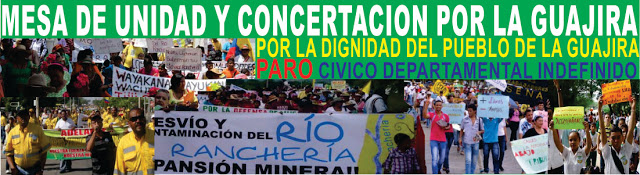
DEPARTMENT-WIDE INDEFINITE CIVIC STRIKE – LA GUAJIRA


We make a call to organized sectors in La Guajira, mayors, council members, the political and civic leadership, the unions, and the people in general to support and join this call for a permanent and indefinite strike.
This strike is divided into the following steps :

Monday, April 8, 2013

The Other Face of Development in Colombia:
Living as Minorities amidst Civil War, Hydrocarbon and Mining Exploitation,
and Generalized Human Rights Violations


If you live around the San Diego area, attend this event

The Other Face of Development in Colombia: Living as Minorities amidst Civil War,
Hydrocarbon and Mining Exploitation, and Generalized Human Rights Violations

Colombia is currently engaged in a peace negotiation that may end Latin America’s longest civil war after five
decades. The country has already adopted a new more democratic constitution and made some progress in
demobilizing right wing paramilitary groups, though a number of criminal gangs have risen in their place. Like
other Latin American countries, Colombia has also pushed forward a national development project focused on public and private international oil and mining projects aimed at stimulating economic growth and promoting energy security. Progress on these fronts, nevertheless, has its ugly side. Indigenous peoples, Afro-Colombians and women have expressed their concern that the manner in which the
government pursues these goals undermines the security, safety and health of
the most vulnerable in Colombia. This event presents their experiences and
provides an opportunity for students to gain insights into the challenges raised
by efforts to promote peace and development that will benefit people in their
local communities and not just national statistics. UCSD Faculty Discussants
will provide a comparative perspective on the Colombian experience. Join us
for an award-winning documentary, panel discussion and reception.

Attention from the Washington Office on Latin America (WOLA
for the latest developing concerns of indigenous rights in Colombia


April 5, 2013
The Washington Office on Latin America (WOLA) wishes to bring to your attention the following developments concerning indigenous rights in Colombia.
Alarming Human Rights Situation for Indigenous Groups
The Colombia National Indigenous Organization (Organización Nacional Indígena de Colombia, ONIC) presented a disturbing report on March 14, 2013, at the OAS Inter-American Commission on Human Rights on the alarming situation indigenous groups face due to violence, displacement, discrimination, poverty, and institutional abandonment by the Colombian government. The report highlighted the critical condition of over 66 indigenous groupings that face cultural and physical extermination; many of whom have a population of less than 500 people. Their livelihood is affected by military operations and mining concessions in their territories, which in some instances totals 54 percent of an indigenous reservation.

Wednesday, March 6, 2013

Moratorium of large mining and the majority
of the regional national park area of Santurbán,
requested by the Departmental Assembly

As you can read here, the impacts of mining by multinational corporations are not only a problem in La Guajira...


Press Office of Representative Roberto Schmalbach, Bucaramanga, November 28, 2012

 With the assistance of the Plateau of Bucaramanga Defense Board, CDMB, the director of AMB, some of the mayors and town councilmen of North Soto, the Comptroller and the Attorney General, the regional director of national natural parks, the legislators and the environmental and civic organizations which fight for preservation of the water and the ecosystem of the páramo, the debate over the declaration about the Natural Park, proposed by the Representatives Carlos Alberto Morales and Roberto Schmalbach, was held in the departmental Duma. 

Wednesday, February 20, 2013

Mining in Colombia by Alvaro Pardo

This is what Alvaro Pardo, an economist investigator from Punto Medio and former President of Carbocol and other institutions from the Colombian Ministry of Mines and Energy, says during the Forums in La Guajira regarding some of the economic and political facts of mining in Colombia. It does not look too good for the local communities living under these economic policies

Tuesday, October 9, 2012

Peace Process in Colombia with Guerrillas

The peace process in Colombia with the Guerrillas has begun. Read here an interesting statement by the AfGJ talking about some of the obstacles that this process faces, including the influence of US and other multinational companies

Peace Talks Begin in Colombia » Counterpunch: Tells the Facts, Names the Names

click to read an article on Counterpunch by academic and activist, Daniel Kovalik, talking about the Peace Process in Colombia
Peace Talks Begin in Colombia » Counterpunch: Tells the Facts, Names the Names