Showing posts with label Call for support. Show all posts

Thursday, May 28, 2015

The community that dies from thirst

La Guajira sequía

A three year old child died of malnutrition last Friday in Uribia, a town of Colombia located in the department of La Guajira, mostly inhabited by the indigenous population Wayuu. The lack of water in recent years has taken the lives of nearly 5,000 children, according to Javier Rojas, leader of the Association of Traditional Indigenous Authorities Shipia Wayuu Wayuu. The more than 400,000 people who make up this community live 365 days a year with temperatures between 35 and 42 degrees, without water. Since a mining company was installed more than 10 years in the region, there has been a decline in the possibilities to access the liquid. The deaths make clear the drama that is lived.
The case has already reached the Inter-American Commission on Human Rights (IACHR), which called on Wednesday the Colombian Government to explain what measures it has taken to address this community and follow up to any attempts they have made to solve the food crisis that also affects those indigenous peoples. At the end of the process, according to Carolina Sáchica, the lawyer handling the case on behalf of the Wayuu, they expect to recover the water from the largest water resource in the area, the Rancheria River, which was dammed for the exclusive use of companies expected engaged in coal mining.

Monday, May 25, 2015

Book exposing Glencore (one of the owners of Cerrejon)!
and its human right, labor, and environmental violations

Swiss-registered Glencore is one of the world's largest companies in  the extractive industry. Glencore's many mines and mining projects have  violated human rights and labour and environmental legislation on  countless occasions. In May 2014, MultiWatch published "Milliarden mit Rohstoffen – Der  Schweizer Konzern Glencore Xstrata", a survey of Glencore's  controversial business practices and of the negative impacts of its  mining projects. MultiWatch now present the English and Spanish version of the book.
Download here:
English and  Spanish


Wednesday, April 15, 2015

International Campaign to stop the diversion of the Bruno Stream

The Cerrejón coal mine in Colombia has already forcibly relocated thousands of people from local communities. Now the mine wants to divert one of the area's few rivers to access more coal - but it is one of the main sources of water for people in the area.
Local communities have joined forces with workers in the mine to stop the river diversion and protect the livelihood of people living in the area. Community opposition recently stopped the company from diverting the arid region's major river to get at 500 million tonnes of extra coal.

Cerrejón is owned by three massive mining multinationals listed on the London Stock Exchange: Anglo American, BHP Billiton and Glencore. Please tell them to respect community rights in Colombia and halt the diversion of the Arroyo Bruno river.

This is a joint action by a coalition of organisations working in solidarity with communities around Cerrejón.

Click here to sign and show your support

Wednesday, March 18, 2015

Public Declaration from La Guajira
after Grand Forum for the defense of the Bruno Stream.


Communities, social and political organizations, environmentalists, workers of the Colombian mining and energy sector, handicraftsmen, indigenous people, students, educators, human rights defenders and other participants in the GRAND FORUM IN DEFENSE OF THE BRUNO STREAM, HEALTH AND THE ENVIRONMENT, held on 4 and 5 March 2015 in Riohacha, make public to the Colombian society and peoples of the world the following conclusions:
Carbones del Cerrejón Limited, in its P40 expansion project, which aims to "increase production from 32 to 40 million tons of coal per year starting from 2015" and in complicity with the government of Juan Manuel Santos, plan to divert the Bruno stream, one of the main tributaries of the Rancheria River. Since over 80% of La Guajira territory is semidesert and its water supply is very fragile, changing the course of this stream can result in the loss of biodiversity, accelerated and increased sedimentation, and severe alterations of evapotranspiration, and a probable death of the stream.

Wednesday, February 18, 2015

Diversion of the Bruno Stream in La Guajira. An environmental absurdity


Once again, it appears that coal mining became an environmental, economic and social scam for a region that expected welfare and progress coming from the exploitation of large mineral reserves, stored for millions of years. The mining-energy locomotive that pulls out the important minerals of the zone is also carrying the hopes of a people who looked for mining extraction a boost for development that would bring decent work, growth and modernity and social transformation.
The results of more than 3 decades of exploitation show another thing: Coal production is equivalent to 61% of regional GDP, but which employs only 3% of the economically active population; a notorious environmental degradation, destruction of tropical dry forest, contamination of surface and groundwater, disappearance of many tributary streams of the River Rancheria, and population displacement as people are forced to leave their ancestral villages to give place to mining. Poverty, drought, violence, poor health and insecurity are notorious in a territory that is generously endowed by nature.

Tuesday, February 10, 2015

FOR THE WAYUU, THE ARGUMENTS TO DIVERT THE BRUNO STREAM ARE MERE STORIES TO DECEIVE FOOLS!


The Wayuu communities settled on the banks of the Bruno Stream and other social organizations gathered on Saturday February 7 in the ancestral ranchería of Paredero, of the Municipality of Albania, La Guajira. The objective of this meeting was to discuss the claims of Cerrejón that, with the complicity of the government of Juan Manuel Santos, wants to divert the Bruno Stream, one of the tributaries of the Rancheria River, with the sole purpose of the increase of profit of multinational corporations. As a result, we give the following public communique form La Guajira, Colombia:
For the Wayuu, the water, as it is the Bruno Stream, means the veins of Wounmain - Our territory - that is in charge of fertilizing the cultural riches, including what allows us to have food sovereignty and life itself.

26th of February: Departamental March in Defense for the Bruno Stream

The purpose of diverting the stream Bruno by the multinational company Cerrejón generated a unison reaction various social sectors of La Guajira. Unions and the Civic Committee for the Dignity of La Guajira unveiled their resolution to conduct a series of activities, in order to visibilize the feeling of the Guajira community regarding this event. For February 7, unionists and The Civic Committee are calling traditional authorities, governors and indigenous Wayuu leaders to a meeting In Paredero in order to hear the position of the indigenous people, and coordinate the participation of the ethnic groups in the mobilization for the defense of water and life.
For February 19, there will be a departmental Union plenary, while on February 26, there will be a march in defense for Bruno stream.

Saturday, October 18, 2014

Coal miners against Coal?

– By Ewa Jasiewicz on October 8, 2014


in Union Solidarity International (original at: https://usilive.org/coal-miners-against-coal/)

Freddy Lozano leads a union of coal miners who are against coal mining.

Let me break that down for you. SINTRACARBON, headquartered in Riohacha, North Eastern Colombia, organises in one of the biggest open-cast coal mines on earth – Cerrejón. The name is taken from the indigenous Wayuu peoples’ name for the area meaning ‘Sacred Mountain’. Over the past 30 years that sacred mountain has become a vast network of pits run by Anglo-American, BHP Billiton and Glencore Xstrata. Seventeen indigenous and Afro-Colombian communities have been displaced and see the operation, in the words of Aurellio, a leader from the Campo Allegre community, as ‘terrorism against our people’.
Cerrejón mine
It was when Freddy, President of the Porto Bolivar Section, visited communities impacted by the mine eight years ago that he and the union embarked on a journey that would see them protest side by side with community members last year against the expansion of the mine.
The company wanted to access 500 millions tons of coal under the Rio Rancheria river, the only major river in the dry province of La Guajira, by diverting it for 26.2 kilometres. Local communities reliant on the river were outraged.

PUBLIC STATEMENT AND MEETING OF UNIONS, AND SOCIAL AND POLITICAL ORGANIZATIONS FOR THE DIGNITY OF LA GUAJIRA


Social, political, rural, communal, indigenous and Afro-Colombian organizations, as well as various unions, met on May 15, 2014, at the Civic Committee for the Dignity of La Guajira with the aim of:
Consult and approve the List of Demands for the Dignity of La Guajira to be sent to the National Government and multinational Cerrejón Limited, Public Enterprises of Medellin and Ecopetrol Association - Chevron Texaco, and
To define in conjunction, a preparatory agenda of social mobilization of a departmental civic strike of the Guajiro people.
Consensus of Collective Considerations Derived from the Encounter:
We reaffirm our rejection of neoliberal policies that have been implemented in the country  over four lustrous decades in the presidency of Juan Manuel Santos, resulting in the delivery of natural resources to multinationals, privatization of public services, education and health, cutting of labor guarantees and measures against the agricultural sector, especially the Free Trade Agreement – NAFTA – with the United States, reducing transfers to departments, municipalities and indigenous reservations and the robbing of privileges, thereof.
We reject these government policies that have plunged La Guajira into deep crisis; it has amplified the gap of social inequality and has positioned us as one of the most unequal societies on the planet.
We also reject the following disastrous consequences suffered by the Guajira, which derived from this neoliberal monster:

Thursday, August 7, 2014

SUPPORT THE PEOPLE OF LA GUAJIRA IN THEIR PROTESTS

ATTENTION!


Please take a moment to add your name to the international solidarity effort in support of the communities affected by Cerrejón.  They have put a huge effort into their Aug 7-9 events where communities currently under threat will join with those already displaced to protest the impact of the mine and to demonstrate the ways in which Cerrejon has manipulated the process of "prior consultation"


Please click here:


http://action.wdm.org.uk/ea-action/action?ea.client.id=1784&ea.campaign.id=30766


for more information and to sign the petition supporting their demands.

Thursday, July 24, 2014

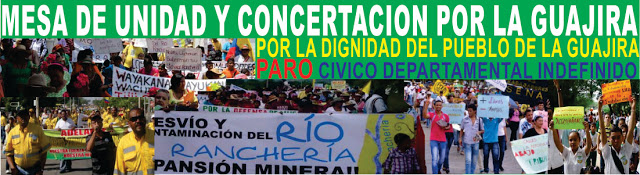
INDEFINITE CIVIL STRIKE FOR THE DIGNITY OF LA GUAJIRA STARTING ON AUGUST 28


INDEFINITE CIVIL STRIKE FOR THE DIGNITY OF LA GUAJIRA STARTING ON AUGUST 28 

As a result of the implementation of a mining and energy model of extraction of natural resources through multinational companies, the peasants and different sectors in La Guajira live a crisis whose most sinister aspects include the enormous and ever growing social inequality, which measured through the Gini coefficient, has risen from 047 in 2002 to 061 in 2010; the low coverage of aqueduct (51.64%) and sewerage (38.96%); the Index Unsatisfied Basic Needs (UBN) of 65.23%; and the chronic malnutrition of 27% making it one of the highest rates in the country.

Given the above, the Civic Committee for the Dignity of La Guajira, at its meeting today, July 22, made ​​the following determinations: 

1. to request the National Government, the departmental government, and multinational companies to form a single table for negotiation to discuss the demands that includes the aspirations of the people of La Guajira. 

2. To invite the Guajiro people to join for an indefinite general departmental strike starting on August 28 of this year

3. The following Tuesday July 29, a meeting will discuss the organizational aspects for the development of a plan leading to link large sections and sectors in this strike.


CENTRAL POINTS OF THE LIST OF REQUESTS FOR THE SALVATION AND DIGNITY OF LA GUAJIRA TO BE DISCUSSED WITH THE GOVERNMENT AND MULTINATIONAL COMPANY CERREJON

1. The creation of a fund for development and Compensation for the dignity of the Guajira, by which the Colombian state and the multinational companies exploiting natural resources in La Guajira will pay the huge social debt to the different social and ethnic groups in La Guajira as a result of the immense and irreversible environmental, social, economic and cultural impacts. This fund will also ensure the compensation of future impacts on the Guajira people, as it should be done with the social responsibility programs arising from the exploitation of non-renewable natural resources. 

2.- The creation of a plan for management of natural resources to ensure sustainable development (its conservation, restoration or replacement) and, thus, preventing and controlling environmental deterioration by being able to impose legal sanctions and claims when demages have occurred.

3.- Plan and fund for the promotion of productive projects based on agriculture, industry, water management, and tourism in order to generate productive employment and ensure food sovereignty in the department. 

4. Improve the quality of life of the communities in La Guajira so that the wealth generated by the exploitation of natural resources be shared with all those social sectors through jobs, quality public services, food, health, education and housing 

5. To request thr Colombian State to guarantee democracy and the full use of public rights and freedoms for peasants and other social and ethnic sectors in La Guajira

Thursday, July 3, 2014

People of the Guajira Endorse The Civic Committee for Dignity in the Guajira's Call for a Civic Strike

Today, on May 1, International Workers' Day, workers, peasants, students, teachers, Wayuu indigenous people, community leaders, municipal officials, people displaced by the Cerrejón mine, and women took the streets in La Guajira's capital, calling out "Yes to the Civic Strike, They are calling us to strike, we will!" which referred to the calling of the civic strike by various civil society organizations, grouped under the Civic Committee for Dignity in the Guajira.


The application of the extractive mining and gas model, the opening of the economy, and cuts to public spending have led to the worst crisis in our department's history. The crisis is in the rising inequality: the Gini coefficient has risen from 0.47 in 2002 to 0.61 in 2010; the loss of food security; 28 % of territory in mining concession; the decline of the peasant economy.   The statistics reflect this great social tragedy: 51.64 % of the region has low aqueduct access and 38.96 % low sewer system access, 65.23 % of people do not meet Basic Needs and 27 % suffer from chronic malnutrition, one of the highest rates in the country.   


La Guajira has become one of zones with major energy resources with over 3 billion tons of coal, 60 % of the country's natural gas and produces 560 MW of electricity to meet national demand.  


But these riches are not exploited to meet the development needs of the department or bring progress to the people.  While multinational corporations obtain operational utilities of 37.7 %, 60 % of people in the Guajira earn less that 200 thousand pesos ($100 USD) per month and 38 % makes less than 90 thousand pesos ($45).


Mining, which makes up 61% of GDP, generates only 2.9 % of employment in La Guajira. That is to say, the jobs lost in agriculture have not been made up in mining employment.  Unemployment in 2010 rose to 9.2 % from 5.7 % in 2005, and insufficient employment rose to 122 thousand people.


Our natural water sources are low, and in 12 municipalities, very low, and there is high and very high water vulnerability in 33% of the same areas. Coal mining has aggravated the problem, destroying natural aquifers in 8 water bodies including ravines and tributary streams of the Ranchería River and has affected 11, 488 hectares of forest.  The mine has only rehabilitated about 3000 hectares of this land.


Civil society organizations grouped under the Civic Committee for the Guajira have called for all social sectors: civic, trade, institutional and political leadership to organize a department-wide civic strike.  The Civic Committee for Dignity in La Guajira will lead the strike with participation from municipal committees and other organizations and sectors who want to participate in the strike.


The Civic Committee for Dignity will prepare a letter in the Casa de Nariño, presidential office, on May 7, containing a summary of the list of petitions from 2013, focusing on the most pressing needs of people in the Guajira, and will ask the government to mediate in negotiations with Carbones de Cerrejón and Associación Ecopetrol Chevron Texaco.  On May 15, the Committee will host a meeting between social, union, and community organizations, to approve the civic strike, create a mobilization plan that will include strike committees in every municipality, neighborhood, street, school, university, as well as the plans for marches, rallies, blockades, and longer marches with the different social sectors in order to make the strike successful across the Guajira.


The completion of the strike will depend on the National Government, the multinational shareholders of Cerrejón, and the association Ecopetrol Chevron Texaco paying attention and confirming the need for negotiation committees, and their will to resolve the problems from the list of petitions.


The Civic Committee for the La Guajira:


Tuesday, September 3, 2013

Indigenous peoples in Cauca march for the support of the National Agrarian Strike in Colombia


On Tuesday, it is expected that nearly 5,000 thousand Indians arrive in the city of Popayan, following its announcement to support the National Agrarian Strike.
The mobilization will start from the place known as La Maria, in Piendamó, reaching the bridge of the river of Rioblanco, to, then, advance to the historic center of Popayan.

This day of action is organized by members of the Regional Indigenous Council, CRIC, the ONIC (Colombian National Indigenous Organization), and other social organizations.


"This peaceful demonstration will be carried out in a time when the national agriculture strike has notified the entire national population that farmers, indigenous peoples and Afro-descendants will not be ignored and will not be disposed from our territories through the current legislation, which has as its main prop the development of the FTAs with countries such as the United States and those in the European Union ", reported spokesmen Regional Indigenous Council of Cauca, CRIC.

Letter from Colombia Solidarity Campaign
to AngloAmerican, one of the owners of Cerrejon
protesting the expropriation of Roche in La Guajira

Colombia Solidarity Campaign,
BM Box Colombia Solidarity,
London WC1N 3XX
email: info@colombiasolidarity.org.uk

Sir John Parker, Chairman
and Mark Cutifani, Chief Executive,
Anglo American plc,
20 Carlton House Terrace,
London SW1Y 5AN.

27 August 2013

Dear Sir John Parker and Mark Cutifani,

We wish to express our outrage at the planned expropriation of the old village of Roche in La Guajira, Colombia.

This expropriation is a violation of the rights, dignity and wellbeing of the eight families remaining in the village. The judge in San Juan del Cesar who authorised this act of violence was acting at the request of Carbones del Cerrejon, in which your company owns a one-third share.

Among the inhabitants of the village are around fifteen children aged between one and fifteen years, ten adult women and two elderly people.

This eviction is the latest example of the systematic pressure and abuse which this community, along with many others in the area, has been suffering over the past thirty years as a result of opencast coal mining. The initial promise of development and improvement in living conditions has been transformed into a reality of eviction and impoverishment. Thousands of people have been displaced, and many who have remained have suffered loss of livelihood and cultural impoverishment as a result of environmental destruction.

The Colombian State has not complied with the order of the Supreme Court of Justice of 13 September 2012, which demanded that a process of prior consultation be undertaken in the area. The forced displacement of Roche would be a negation of the community’s constitutional rights and a threat to the community’s ability to make any kind of living.

The eight families remaining in Roche have resisted a process of relocation which has involved inordinate pressure on residents to sell up at minimal prices and move to a new community which has inadequate land for the cattle herding on which some of the families have relied for their livelihood. Some of the residents of the new community report that the economic development projects promised by Cerrejon Coal as a replacement for agricultural work have been badly mismanaged by the company and have left people in a state of need.

The way the relocation has been handled has split the community. Negotiators for the remaining eight families, and North American observers of the negotiation process, report that officials from Carbones del Cerrejon have shown deep disrespect for the farming families, refusing to take seriously many of the matters which Roche residents have raised. It is this disrespect which has led to the present stalemate. The company has responded to the stalemate not with a new attempt at respectful negotiation but with legalised brutality.

The eight families at old Roche are terrified that what happened at Tabaco on 9 August 2001 is about to happen to them. Former residents of Tabaco, violently evicted on that day, were scattered to various locations and their community life destroyed. Despite a settlement with Carbones del Cerrejon after many years of struggle, the people of Tabaco have still not been able to take possession of the new community which they were promised. Depression and ill health have afflicted some of them as a result.

The remaining villagers at Roche were due to be forcibly evicted on Thursday 29 August. Pressure from villagers and their supporters has led to the postponement, but not the abandonment, of the planned eviction. What is needed at old Roche is not forced displacement but a changed attitude on the part of company negotiators so that a just settlement can be reached.  We demand that the company negotiate in good faith in order to come to an agreement, and not continue with the expropriation.

Yours sincerely,


Andy Higginbottom,

Secretary, CSC.

DEPARTMENT-WIDE INDEFINITE CIVIC STRIKE – LA GUAJIRA


We make a call to organized sectors in La Guajira, mayors, council members, the political and civic leadership, the unions, and the people in general to support and join this call for a permanent and indefinite strike.
This strike is divided into the following steps :

The Guajiros marched once again in August 20th


In August 20th, inhabitants of La Guajira and members of different social sectors marched against the poor energy, water, and garbage disposals services provided in the department. In addition, people demanded improvement of the environmental problems left by large-scale mining, the health services and its networks of corruptions, the use of contracting companies for hiring health and education workers, the national system of royalties and against the US free-trade agreement.
Sponsored by:

MESA DE CONCERTACION POR LA GUAJIRA, CUT GUAJIRA, SINTRACARBON, ASODEGUA, COMITÉ CIVICO EN DEFENSA DEL RIO RANCHERIA, AACIWASUG, LA MANE, FUERZA DE MUJERES WAYUU, FECODEMIGUA, SINDESENA, SINTRABIENESTAR, RECLAME GUAJIRA, CODEPAZ, CENTRO DE ESTUDIOS DEL CARBON,LIGAS DE USUARIOS DE LOS SERVICIOS PUBLICOS.

El Cerrejon Mine in Colombia attacks communities
No Pasaran!


Scenes from Tabaco 2001.  Stop this from happening again

STOP THE FORCED EVICTION OF VILLAGERS IN ROCHE
TO MAKE WAY FOR A COAL MINE

Cerrejon Coal and the Colombian courts are threatening to evict indigenous and afro-descendent villagers at Roche, in the northern province of La Guajira, on Thursday 29 August. They want to expand their massive opencast mine. Cerrejon Coal is owned by three mega mining multinationals (Anglo American, BHP Billiton and Glencore Xstrata) and exports most of its coal to power plants in the eastern United States, including the Brayton Point plant in Somerset, MA.

Tuesday, May 7, 2013

MEETING ON MINING AND ENERGY ON THE COLOMBIAN CARIBBEAN
TOWARD A NEW NATIONAL MINING POLICY


MEETING ON MINING AND ENERGY ON THE COLOMBIAN CARIBBEAN
TOWARD A NEW NATIONAL MINING POLICY AND THE COMPENSATION FOR THE SOCIO-ENVIRONMENTAL IMPACTS FROM MINING TO THE GUAJIRO PEOPLE

Riohacha, University of La Guajira, 9 and May 10, 2013


1.       Justification

Open pit mining has been practiced in Colombia as a result of its inclusion into the neoliberal international division of labor. This involves the use of financial capital from large multinational companies that have brought deep economic, social, cultural and environmental impacts, while undermining our national sovereignty.

Monday, April 8, 2013

Attention from the Washington Office on Latin America (WOLA
for the latest developing concerns of indigenous rights in Colombia


April 5, 2013
The Washington Office on Latin America (WOLA) wishes to bring to your attention the following developments concerning indigenous rights in Colombia.
Alarming Human Rights Situation for Indigenous Groups
The Colombia National Indigenous Organization (Organización Nacional Indígena de Colombia, ONIC) presented a disturbing report on March 14, 2013, at the OAS Inter-American Commission on Human Rights on the alarming situation indigenous groups face due to violence, displacement, discrimination, poverty, and institutional abandonment by the Colombian government. The report highlighted the critical condition of over 66 indigenous groupings that face cultural and physical extermination; many of whom have a population of less than 500 people. Their livelihood is affected by military operations and mining concessions in their territories, which in some instances totals 54 percent of an indigenous reservation.