Thursday, July 3, 2014

People of the Guajira Endorse The Civic Committee for Dignity in the Guajira's Call for a Civic Strike

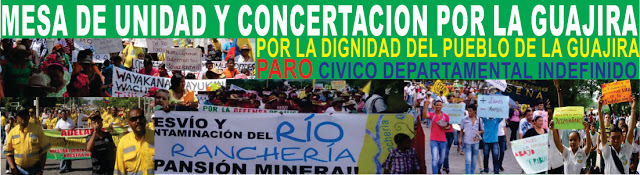
Today, on May 1, International Workers' Day, workers, peasants, students, teachers, Wayuu indigenous people, community leaders, municipal officials, people displaced by the Cerrejón mine, and women took the streets in La Guajira's capital, calling out "Yes to the Civic Strike, They are calling us to strike, we will!" which referred to the calling of the civic strike by various civil society organizations, grouped under the Civic Committee for Dignity in the Guajira.


The application of the extractive mining and gas model, the opening of the economy, and cuts to public spending have led to the worst crisis in our department's history. The crisis is in the rising inequality: the Gini coefficient has risen from 0.47 in 2002 to 0.61 in 2010; the loss of food security; 28 % of territory in mining concession; the decline of the peasant economy.   The statistics reflect this great social tragedy: 51.64 % of the region has low aqueduct access and 38.96 % low sewer system access, 65.23 % of people do not meet Basic Needs and 27 % suffer from chronic malnutrition, one of the highest rates in the country.   


La Guajira has become one of zones with major energy resources with over 3 billion tons of coal, 60 % of the country's natural gas and produces 560 MW of electricity to meet national demand.  


But these riches are not exploited to meet the development needs of the department or bring progress to the people.  While multinational corporations obtain operational utilities of 37.7 %, 60 % of people in the Guajira earn less that 200 thousand pesos ($100 USD) per month and 38 % makes less than 90 thousand pesos ($45).


Mining, which makes up 61% of GDP, generates only 2.9 % of employment in La Guajira. That is to say, the jobs lost in agriculture have not been made up in mining employment.  Unemployment in 2010 rose to 9.2 % from 5.7 % in 2005, and insufficient employment rose to 122 thousand people.


Our natural water sources are low, and in 12 municipalities, very low, and there is high and very high water vulnerability in 33% of the same areas. Coal mining has aggravated the problem, destroying natural aquifers in 8 water bodies including ravines and tributary streams of the Ranchería River and has affected 11, 488 hectares of forest.  The mine has only rehabilitated about 3000 hectares of this land.


Civil society organizations grouped under the Civic Committee for the Guajira have called for all social sectors: civic, trade, institutional and political leadership to organize a department-wide civic strike.  The Civic Committee for Dignity in La Guajira will lead the strike with participation from municipal committees and other organizations and sectors who want to participate in the strike.


The Civic Committee for Dignity will prepare a letter in the Casa de Nariño, presidential office, on May 7, containing a summary of the list of petitions from 2013, focusing on the most pressing needs of people in the Guajira, and will ask the government to mediate in negotiations with Carbones de Cerrejón and Associación Ecopetrol Chevron Texaco.  On May 15, the Committee will host a meeting between social, union, and community organizations, to approve the civic strike, create a mobilization plan that will include strike committees in every municipality, neighborhood, street, school, university, as well as the plans for marches, rallies, blockades, and longer marches with the different social sectors in order to make the strike successful across the Guajira.


The completion of the strike will depend on the National Government, the multinational shareholders of Cerrejón, and the association Ecopetrol Chevron Texaco paying attention and confirming the need for negotiation committees, and their will to resolve the problems from the list of petitions.


The Civic Committee for the La Guajira:


Friday, June 27, 2014

Letter from a Wayuu indigenous woman to the public opinion: “My reasons for NOT voting for Juan Manuel Santos nor Oscar Zuluaga

By Ussyunu Epiayu, May 28, 2014

First, I want to address any and all Colombians who defend national sovereignty. Also, I want to thank the indigenous brothers, African descents, peasants, sisters and brothers of the left, and all those who trusted the real proposals of Clara Obregón López. "Clara lo tiene Claro” demonstrates how the two million votes and the 70% of abstention are the real winners of the elections on May 25, 2014. These give credibility and confidence to the ideology as consolidated now in the left. 

Today, being 5:13 pm, I allow myself to write this letter from my status as an activist Wayuu woman and leader, as a manifesto of "my reasons for NOT voting by Juan Manuel Santos nor Oscar Iván Zuluaga." Brothers and sisters, with my sincere words I do not seek to be recognized. Rather, I only seek to raise awareness and find consistency as I know many of my sisters and brothers who follow me on social networks, will think I'm crazy since this may be taken as an opposition of the so-called Peace ? But my conviction and good thinking has led me to reflect that today my country, your country, our country Colombia, has been falling apart for long 25 years of Neoliberal reforms through which a giant Empire, along with a few warlords and wealthy elites have acted as the of the varied natural resources that rest in our country. However, as has been reflected through the marches and collective proposals that have lately taken place for the protection and safeguarding national sovereignty, these resources are collective.

Indigenous and non-indigenous, the 13,000 votes casted in Wounmainkat, La Guajira department, supporting Clara Lopez, is today, a reflection of the voices of those brothers and sisters who believe in real proposals for an economic and political model built from the bases. 

Today, I wish to inform you that my department of La Guajira houses natural resources that reach 43 .4% of the national proven gas reserves, supplying domestic demand by 60% as well as 56.6% of the proven coal reserves, which are equivalent to 3,728 million tons, generating 560 MW of electrical power for the nation. 

Nevertheless, today, the realities among indigenous communities, farmers, African descendants, and other sectos show the true Guajira wrapped in Extreme Poverty, poor conditions of public services, and a fully contaminated Guajira as a result of the corporations that took over the whole department of la Guajira. The most alarming aspects for me are, thus, the social inequality, expressed through the Gini coefficient that when from 0.47 in 2007 to 0.61 in 2010; the low aqueduct (51.64%) and sewerage (38.96%) coverage; an index of unsatisfied basic needs (NBI) of 65.23%; and a chronic malnutrition of 27%, being one of the highest rates in the country. 

The departmental GDP which by the mid-70's in terms of agriculture was more than 20%, in 2010 only reaches 4.6%. In other words, mining, which is 61% of the GDP, generates only 2.9% of the local jobs; certainly, much less than in agriculture. Hence, unemployment in 2010 was 9.2%, much higher than the 5.7% in 2005 while underemployment reached 122000 people. Up to 2012, more than 540 million tons of coal had been exported, with revenue for the mining company Cerrejón of 23,800 million dollars. Neverteless, Colombia only obtained royalties of $ 2,006,000 dollars, or the 8.42% of total earnings. Similarly, while multinational corporations operating profits reached 37.7%, 58% of the peasants in La Guajira live on less than 200000 pesos (around 110 dollars) per month, and 38% with less than 90000 pesos (50 dollars). Mining and multinational corporations have not been a sign of development and progress but, instead, immense environmental, social and cultural liabilities.

Thus, I cannot be so irresponsible as to think or repeat such common lies deceiving many of our Colombian brothers of  "vote for peace" "or “Santos is better than Zuluaga". No. Both are cut from the same cloth and both come from the same school of warlords and elites working with the transnational companies operating in the country.


Today, my analysis leads me to lean to the left in Colombia that keeps some consistence consistency. I know many will surely point out that we are not wanting peace for Colombia, but, for these politicians, the focus has not been the search for peace. There is a gentleman named Juan Manuel Santos whose campaign being done in the name of peace is actually for the benefit of the elite. Similar is the perverse example of the way in which Oscar Iván Zuluaga, a cub of Uribe, is based on the false propagandas shown in the media (RCN and Caracol). Sisters and brothers, I also will mention that the focus of the crisis that exists in Colombia is not merely armed conflict, but also the real crisis coming from the neoliberal economic model. The oligarchy cannot cover the sun with one finger. The lies of the governments of the Right have been uncovered by the movement of the peasants, indigenous peoples, and others that have risen in this country. I do not say that peace is not necessary for Colombia. Of course it is! But peace must be accompanied with social justice where changes are generated from local economic models built where the bases can build their own sovereign models. The electoral results show me the failure of Santismo and Uribismo. This is reflected by the Municipality of Piedras, Tolima, where blank votes reached 54.02% as a protest against the exploitation of natural resources of the company Anglo Gold Ashanti. Similarly, places like Taganga (Magdalena) and Baru (Cesar) refused to vote as a result of the failure of the government to meet their basic needs. 

"The economic model is absorbing the country and its sovereignty is at risk," There is a disaster of the FTA. For these reasons: 

"I do NOT Vote for Juan Manuel Santos nor by Oscar Iván Zuluaga." 

“Voting for the Right obliges me to lose my territory and my dignity; Voting for the Right forces you to have no memory”

"Consistency in my daily walk and discourse makes me give reasons not to vote for the Right. I appeal to the good sense and coherence of people to adopt for blank votes or abstention on the second round of elections" 

Sincerely, Ussyunu Epiayu

Tuesday, September 3, 2013

Indigenous peoples in Cauca march for the support of the National Agrarian Strike in Colombia


On Tuesday, it is expected that nearly 5,000 thousand Indians arrive in the city of Popayan, following its announcement to support the National Agrarian Strike.
The mobilization will start from the place known as La Maria, in Piendamó, reaching the bridge of the river of Rioblanco, to, then, advance to the historic center of Popayan.

This day of action is organized by members of the Regional Indigenous Council, CRIC, the ONIC (Colombian National Indigenous Organization), and other social organizations.


"This peaceful demonstration will be carried out in a time when the national agriculture strike has notified the entire national population that farmers, indigenous peoples and Afro-descendants will not be ignored and will not be disposed from our territories through the current legislation, which has as its main prop the development of the FTAs with countries such as the United States and those in the European Union ", reported spokesmen Regional Indigenous Council of Cauca, CRIC.

Letter from Colombia Solidarity Campaign
to AngloAmerican, one of the owners of Cerrejon
protesting the expropriation of Roche in La Guajira

Colombia Solidarity Campaign,
BM Box Colombia Solidarity,
London WC1N 3XX
email: info@colombiasolidarity.org.uk

Sir John Parker, Chairman
and Mark Cutifani, Chief Executive,
Anglo American plc,
20 Carlton House Terrace,
London SW1Y 5AN.

27 August 2013

Dear Sir John Parker and Mark Cutifani,

We wish to express our outrage at the planned expropriation of the old village of Roche in La Guajira, Colombia.

This expropriation is a violation of the rights, dignity and wellbeing of the eight families remaining in the village. The judge in San Juan del Cesar who authorised this act of violence was acting at the request of Carbones del Cerrejon, in which your company owns a one-third share.

Among the inhabitants of the village are around fifteen children aged between one and fifteen years, ten adult women and two elderly people.

This eviction is the latest example of the systematic pressure and abuse which this community, along with many others in the area, has been suffering over the past thirty years as a result of opencast coal mining. The initial promise of development and improvement in living conditions has been transformed into a reality of eviction and impoverishment. Thousands of people have been displaced, and many who have remained have suffered loss of livelihood and cultural impoverishment as a result of environmental destruction.

The Colombian State has not complied with the order of the Supreme Court of Justice of 13 September 2012, which demanded that a process of prior consultation be undertaken in the area. The forced displacement of Roche would be a negation of the community’s constitutional rights and a threat to the community’s ability to make any kind of living.

The eight families remaining in Roche have resisted a process of relocation which has involved inordinate pressure on residents to sell up at minimal prices and move to a new community which has inadequate land for the cattle herding on which some of the families have relied for their livelihood. Some of the residents of the new community report that the economic development projects promised by Cerrejon Coal as a replacement for agricultural work have been badly mismanaged by the company and have left people in a state of need.

The way the relocation has been handled has split the community. Negotiators for the remaining eight families, and North American observers of the negotiation process, report that officials from Carbones del Cerrejon have shown deep disrespect for the farming families, refusing to take seriously many of the matters which Roche residents have raised. It is this disrespect which has led to the present stalemate. The company has responded to the stalemate not with a new attempt at respectful negotiation but with legalised brutality.

The eight families at old Roche are terrified that what happened at Tabaco on 9 August 2001 is about to happen to them. Former residents of Tabaco, violently evicted on that day, were scattered to various locations and their community life destroyed. Despite a settlement with Carbones del Cerrejon after many years of struggle, the people of Tabaco have still not been able to take possession of the new community which they were promised. Depression and ill health have afflicted some of them as a result.

The remaining villagers at Roche were due to be forcibly evicted on Thursday 29 August. Pressure from villagers and their supporters has led to the postponement, but not the abandonment, of the planned eviction. What is needed at old Roche is not forced displacement but a changed attitude on the part of company negotiators so that a just settlement can be reached.  We demand that the company negotiate in good faith in order to come to an agreement, and not continue with the expropriation.

Yours sincerely,


Andy Higginbottom,

Secretary, CSC.

DEPARTMENT-WIDE INDEFINITE CIVIC STRIKE – LA GUAJIRA


We make a call to organized sectors in La Guajira, mayors, council members, the political and civic leadership, the unions, and the people in general to support and join this call for a permanent and indefinite strike.
This strike is divided into the following steps :

The Guajiros marched once again in August 20th


In August 20th, inhabitants of La Guajira and members of different social sectors marched against the poor energy, water, and garbage disposals services provided in the department. In addition, people demanded improvement of the environmental problems left by large-scale mining, the health services and its networks of corruptions, the use of contracting companies for hiring health and education workers, the national system of royalties and against the US free-trade agreement.
Sponsored by:

MESA DE CONCERTACION POR LA GUAJIRA, CUT GUAJIRA, SINTRACARBON, ASODEGUA, COMITÉ CIVICO EN DEFENSA DEL RIO RANCHERIA, AACIWASUG, LA MANE, FUERZA DE MUJERES WAYUU, FECODEMIGUA, SINDESENA, SINTRABIENESTAR, RECLAME GUAJIRA, CODEPAZ, CENTRO DE ESTUDIOS DEL CARBON,LIGAS DE USUARIOS DE LOS SERVICIOS PUBLICOS.